This case study examines the heating demand of the Schwamendingen apartment building, constructed in 1970 and renovated and expanded in 2017. Using Ubakus, the annual and monthly thermal demand before and after the renovation is analyzed, revealing the energy-saving potential of the measures implemented.
Before the heat requirement of a building can be determined, all relevant characteristic data must be recorded. This includes the room volume, the energy reference area and the areas and U-values of all building components in an unrenovated state. The online tool Ubakus offers a precise and user-friendly way of doing this: it enables the individual components of the building to be modelled and the U-values to be calculated automatically. This data forms the basis for the subsequent thermal simulation, which is used to determine the annual heating requirement.
The existing building envelope consists of several characteristic components that were recorded in the simulation. The exterior walls consist of 30 mm cork insulation, 180 mm concrete (type A) or 120 mm concrete (type B) and 4 mm gypsum plaster. Due to the very thin insulation, this construction only has low thermal insulation, resulting in a U-value of over 1 W/m²K. The roof also offers inadequate protection against heat loss with only 35 mm of XPS insulation. The window areas are relatively large and consist of single glazing, which causes considerable energy losses with a U-value of around 2.4 W/m²K.
The architectural data of the existing building shows a net room volume of 4,400 m³ and an energy reference area of 1,760 m². These parameters form the basis for the subsequent analysis of the heat requirement.
The images show the existing components of the building envelope before the renovation, including the type A and type B external walls, the roof, the internal ceiling, the basement ceiling and the floor against the ground. Source: Ubakus
U value [W/m2K] before the renovation
Area [m2] before refurbishment
Exterior wall type A
1.17
864.5
Exterior wall type B
1.21
52.5
Roof
0.76
440
Ceiling basement
0.44
440
Interior ceiling
1.8
1320
Internal wall
2.9
1000
Window
2.4
405
How high is the heat requirement before refurbishment?
After entering all components in the Ubakus tool, a new calculation can be started on the Thermal simulation page. Basic building data such as location, room volume and climatic conditions are defined. These parameters are based on the architectural specifications and create the basis for realistic energy modelling.
In the next step, the previously created and saved building components - including walls, windows, roof and floor surfaces - are integrated into the simulation as enclosing surfaces. This captures the entire thermal behaviour of the building, including the heat flows through the envelope surfaces and the internal energy gains. Careful mapping of these elements is crucial in order to achieve correct calculation results.
Once all inputs are complete and plausible, the simulation starts and Ubakus automatically calculates the monthly and annual heating requirements. This calculation forms the basis for the subsequent analysis of energy losses, which is analysed in detail in the next step.
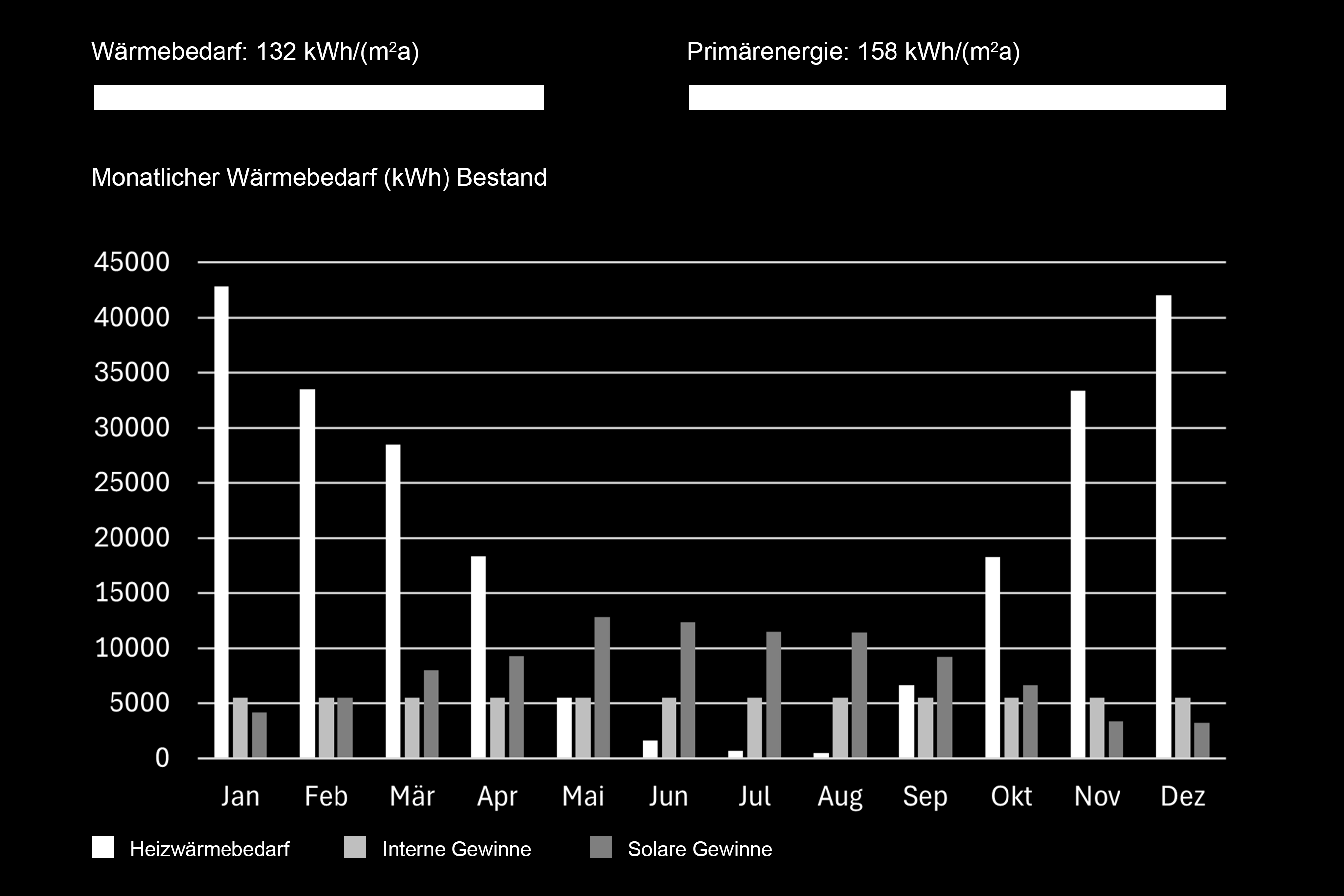
Annual and monthly heat demand and annual primary energy demand before refurbishment. Source: own illustration based on data from Ubakus
The monthly results from the simulation shown above make it clear that the unrenovated building has an extremely high heating requirement. With the exception of the summer months of July and August, there is a significant heating requirement almost all year round. The internal and solar gains are not sufficient to compensate for the heat losses in most months, which means that a continuous heating output is required.
This high energy demand shows that the building's energy consumption is strongly characterised by the heat dissipation via the building envelope. Particularly in the transitional and winter months, insufficiently insulated surfaces lead to considerable energy losses, which reveals the low efficiency of existing constructions.
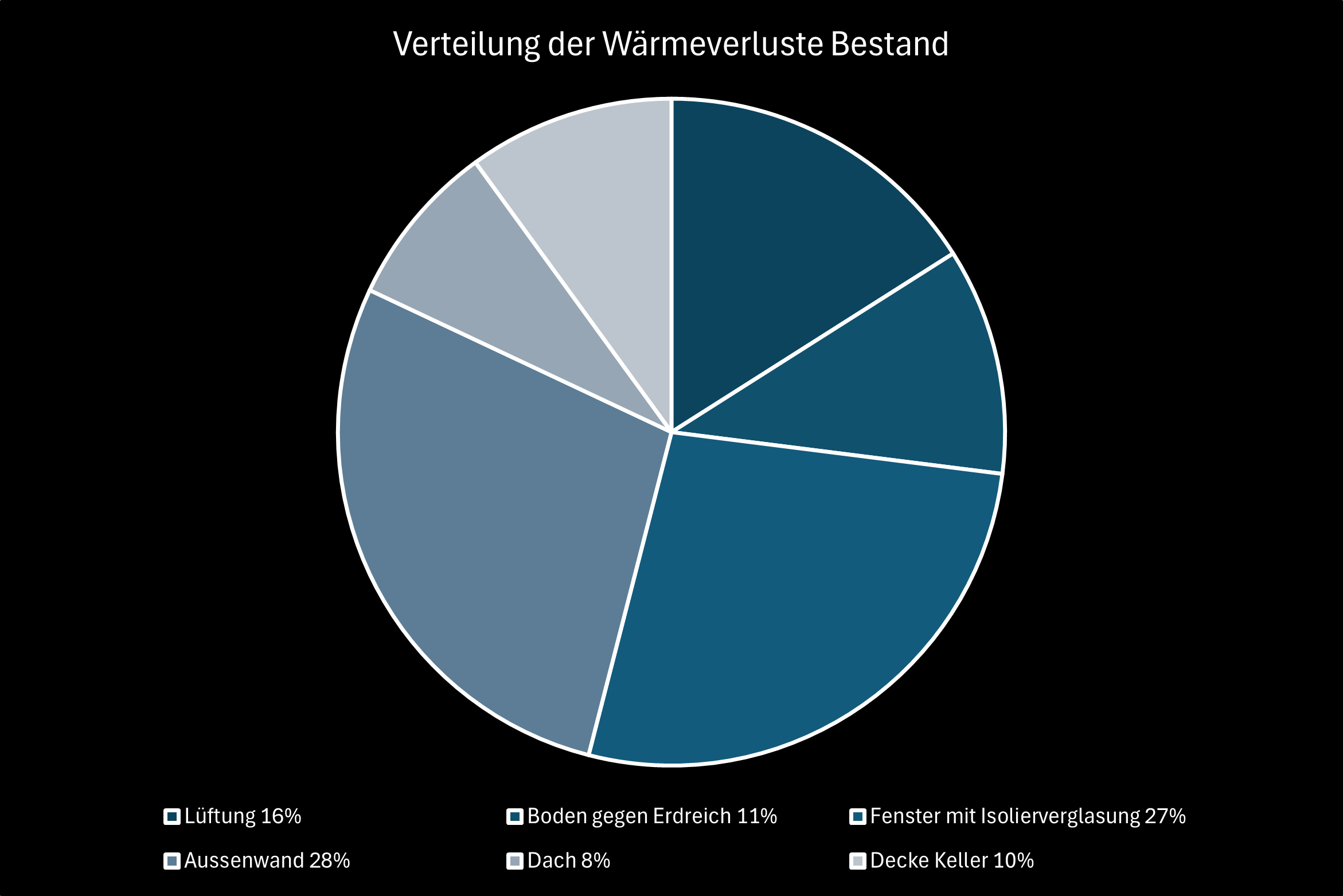
The detailed analysis of heat losses shows that the greatest energy losses occur via the exterior walls and window surfaces. Together, they account for around 55% of total heat loss. The main reasons for this are the poorly insulated exterior walls and the single-glazed windows, whose high U-values significantly increase the heat loss through the building envelope.
Overview of the heat losses of the building in its unrenovated state, based on the simulation results. Source: own illustration based on data from Ubakus
Which refurbishment measures were implemented?
Analysing the building components and heat losses clearly shows that the building's weak point in terms of energy is the building envelope. The inadequately insulated exterior walls and single-glazed windows in particular cause considerable energy losses. Accordingly, the refurbishment measures focus on comprehensively improving the thermal insulation and replacing the windows in order to significantly increase the thermal efficiency of the envelope.
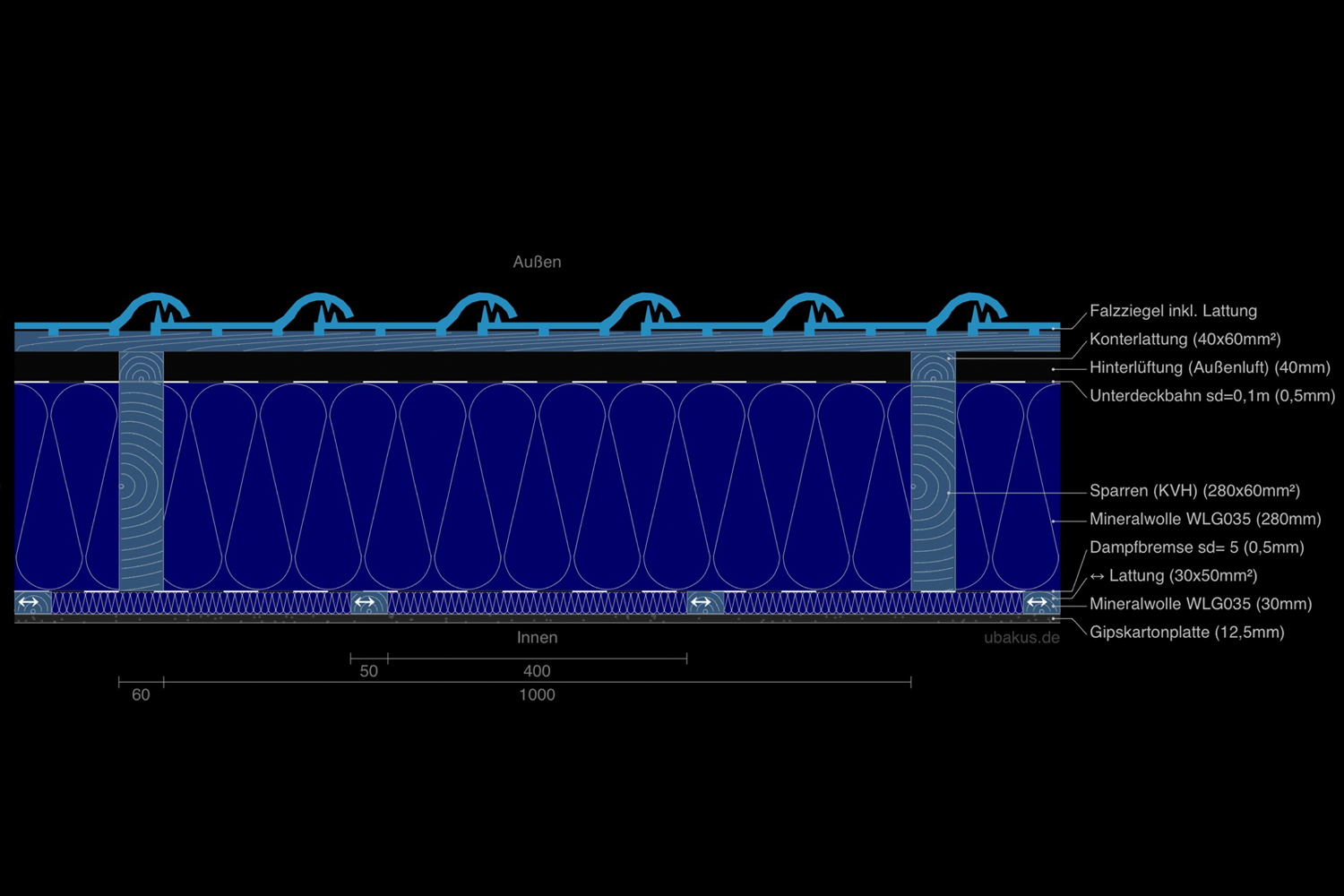
A 220 mm thick mineral wool exterior insulation is planned for the type A exterior wall, while an 80 mm rigid foam PUR layer will be added between the reinforced concrete and the interior plaster for type B. The roof will have an additional 60 mm PUR-AL-K insulation layer as well as further layers of mineral wool and mineral insulation boards, which will noticeably reduce heat loss via the roof surface. The windows will also be completely replaced: triple-glazed thermal insulation windows will minimise energy losses through transparent surfaces in future. Overall, these structural interventions will lead to a significant reduction in the U-values of all envelope components.
In addition to the envelope renovation, the heating system will be modernised and replaced by a heat pump, which will further improve overall efficiency. The floor against the ground remains unchanged as it already has a relatively low U-value. The project also includes an extension, which increases the heated room volume to 5,360 m³ and the energy reference area to 2,144 m². This extension poses a particular planning challenge: The new outer shell must fulfil the same high energy standard in order to sustainably reduce the heating requirement despite the larger building volume.
The images show the renewed components of the building envelope after the renovation, including the exterior walls type A and B, the additional exterior wall of the attic for the new extension, the new roof and the new basement ceiling. The inner ceiling and the floor against the ground remain unchanged and are not shown again in this illustration. Source: Ubakus
U value [W/m2K] before refurbishment
Area [m2] before refurbishment
U value [W/m2K] after refurbishment
Area [m2] after refurbishment
Exterior wall type A
1.17
864.5
0.16
864.5
Exterior wall type B
1.21
52.5
0.28
123.5
Exterior wall DG (new)
/
/
0.14
84
Roof
0.76
440
0.1
440
Ceiling basement
0.44
440
0.23
440
Interior ceiling
1.8
1320
1.8
1704
Internal wall
2.9
1000
2.9
1200
Window
2.4
405
1.4
405
How high is the heating requirement after the refurbishment?
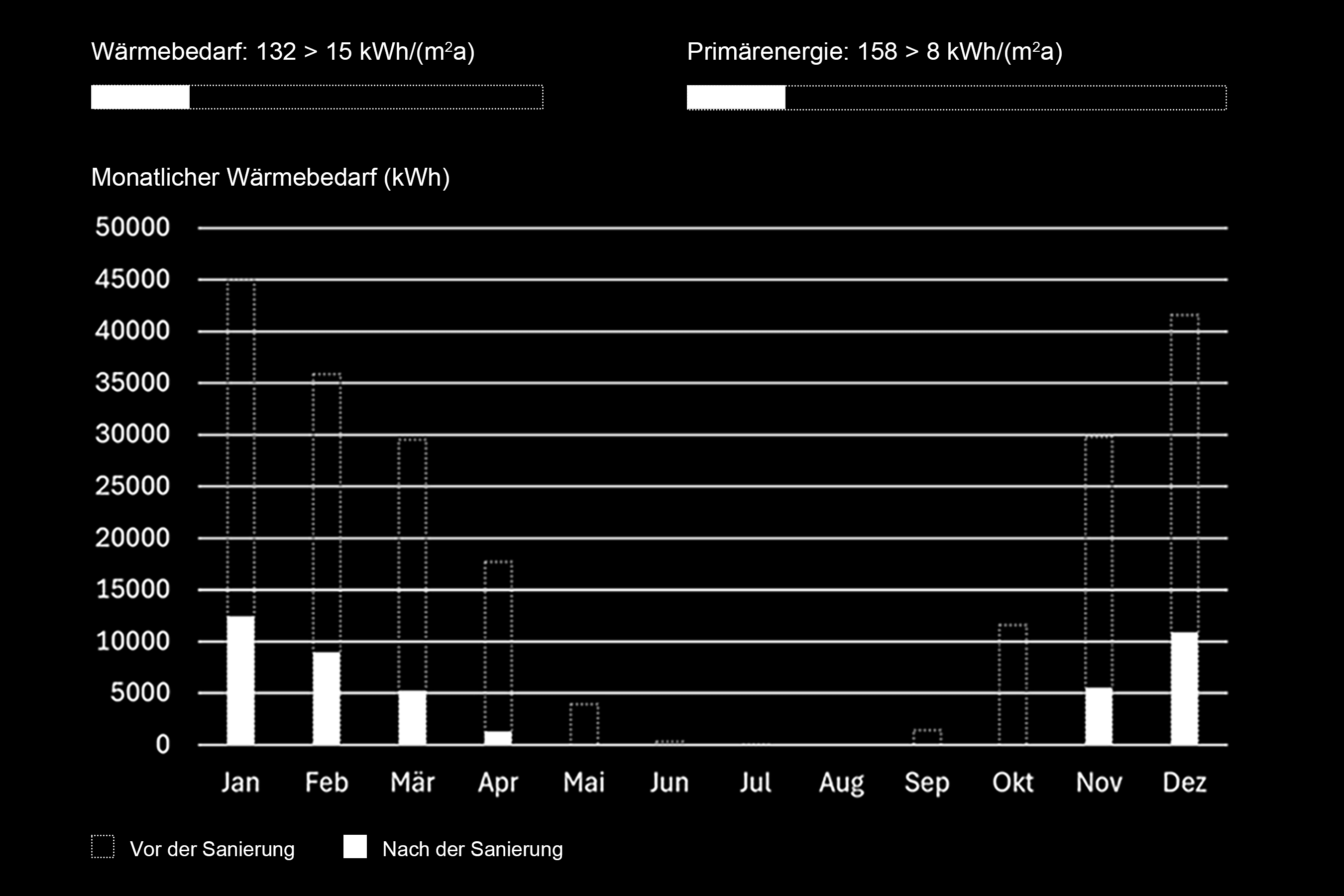
After the components were adjusted in the Ubakus tool and the renovation measures were integrated, the thermal simulation shows a significant improvement in the building's energy behaviour. The newly calculated values illustrate the extent to which renewing the insulation and replacing the windows influence the heating requirement. The tool makes it possible to precisely evaluate the effect of the individual measures in the overall context and to quantify the efficiency of the refurbishment.
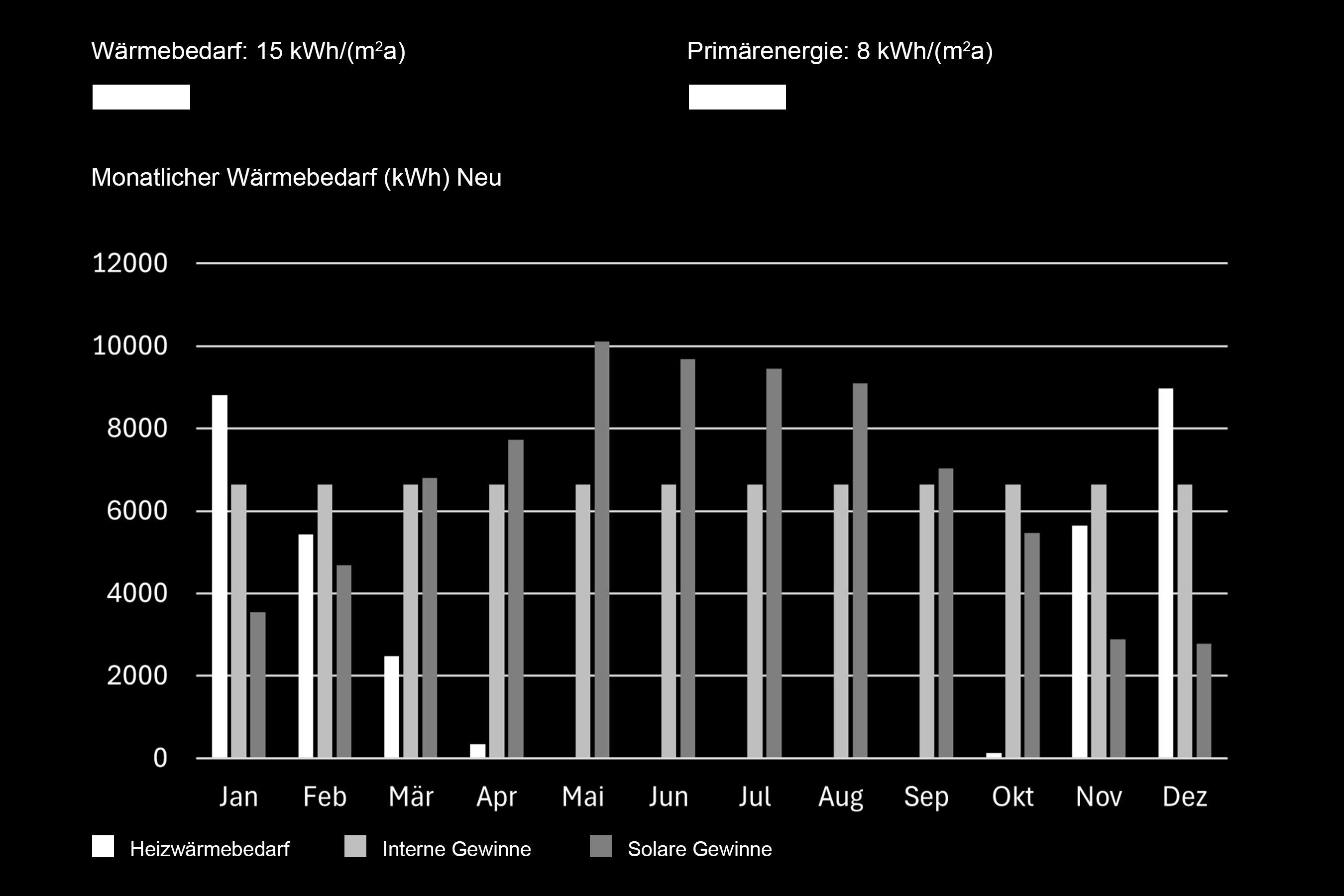
The simulation results show that there is no longer a heating requirement for around half of the year. Particularly in the transitional periods - in spring and autumn - the internal heat gains from people, appliances and solar radiation completely cover the remaining energy demand. As a result, the building remains in thermal equilibrium for large parts of the year, while the heating phases are shorter and significantly more energy-efficient.
In addition to the reduction in heating requirements, primary energy consumption has also been significantly reduced. This is not only due to the improved components of the building envelope, but in particular to the change in the heating system from EL heating oil to a heat pump, which operates at a much higher efficiency. This switch significantly reduces the primary energy requirement, which leads to a noticeable reduction in CO₂ emissions and a more sustainable energy balance for the building overall.
Annual and monthly heat demand and annual primary energy demand after refurbishment. Source: own illustration based on data from Ubakus
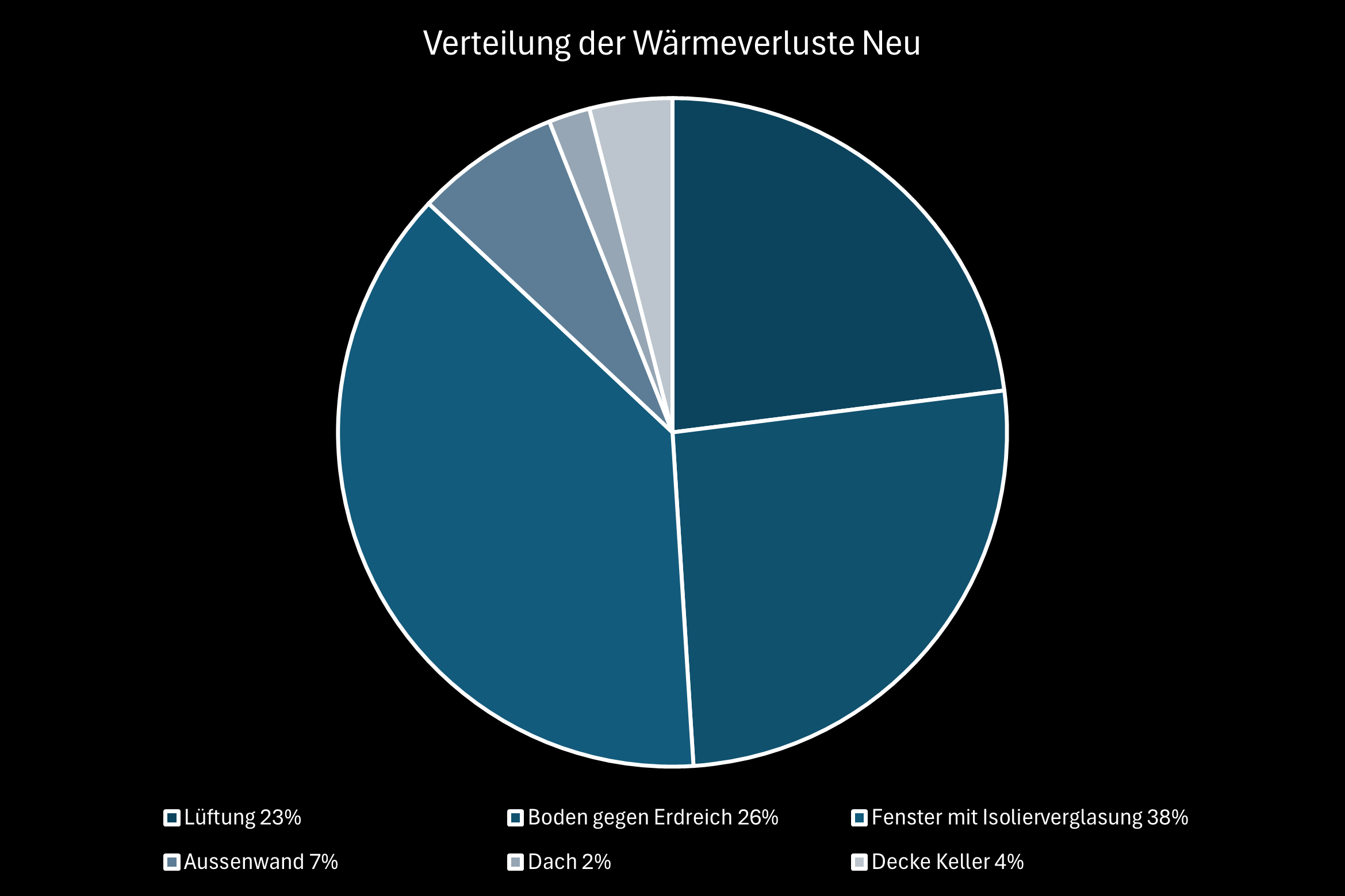
After the refurbishment, the thermal simulation also shows a significant change in the distribution of heat losses. The proportion of losses via the external wall, the roof and the basement ceiling have decreased noticeably. This change confirms the direct effect of the improved insulation and the new envelope structure, which significantly reduce the transmission losses via the large-surface components.
The optimised building envelope distributes the energy loss more evenly across the various components. The thermally insulated surfaces only contribute a small proportion to the overall loss, which means that the building achieves more stable thermal behaviour. At the same time, surface comfort in the interior is improved, as temperature differences between the wall and room air are minimised.
As the window areas and the floor against the ground remained unchanged during the refurbishment, the relative proportion of heat loss now shifts more towards ventilation and ground transmission. Overall, this leads to a more balanced heat balance with significantly reduced overall energy absorption - an indication that the refurbishment measures have successfully eliminated the main sources of loss and improved the building's energy behaviour in the long term.
Overview of the heat losses of the building in its unrenovated state, based on the simulation results. Source: own illustration based on data from Ubakus
How high is the savings potential?
The simulation results show that the refurbishment measures lead to exceptionally high energy savings. The specific heating requirement falls from 132 kWh/m²a to 15 kWh/m²a, which corresponds to a reduction of around 89 %. Primary energy consumption is also significantly reduced - from 158 kWh/m²a to just 8 kWh/m²a, i.e. by around 95 %. These values illustrate just how much the renovation of the building envelope and the change of heating system to a heat pump can improve the overall energy performance of the building.
The reduction in energy consumption per energy reference area shows that the refurbishment not only minimises absolute losses, but also significantly increases the energy efficiency of the entire usable area. The building thus achieves an energy standard that corresponds to that of a modern, well-insulated new building, while at the same time improving its thermal comfort and operating cost balance.
In addition, the significant reduction in heating requirements and primary energy consumption leads to a massive reduction in CO₂ emissions, as hardly any fossil energy is required for operation. The refurbishment therefore not only helps to reduce costs and increase energy independence, but also makes an important contribution to achieving climate targets and the sustainable transformation of the building stock. This example shows how targeted structural measures and the use of digital simulation tools can create an effective combination of ecological responsibility and technical efficiency.
Diese Darstellung zeigt den jährlichen und monatlichen Wärmebedarf sowie den jährlichen Primärenergie vor und nach der Sanierung, basierend auf den oben dargestellten Simulationsdaten. Quelle: eigene Darstellung auf Basis von Daten aus Ubakus
How do the calculated values compare with the SIA standard values?
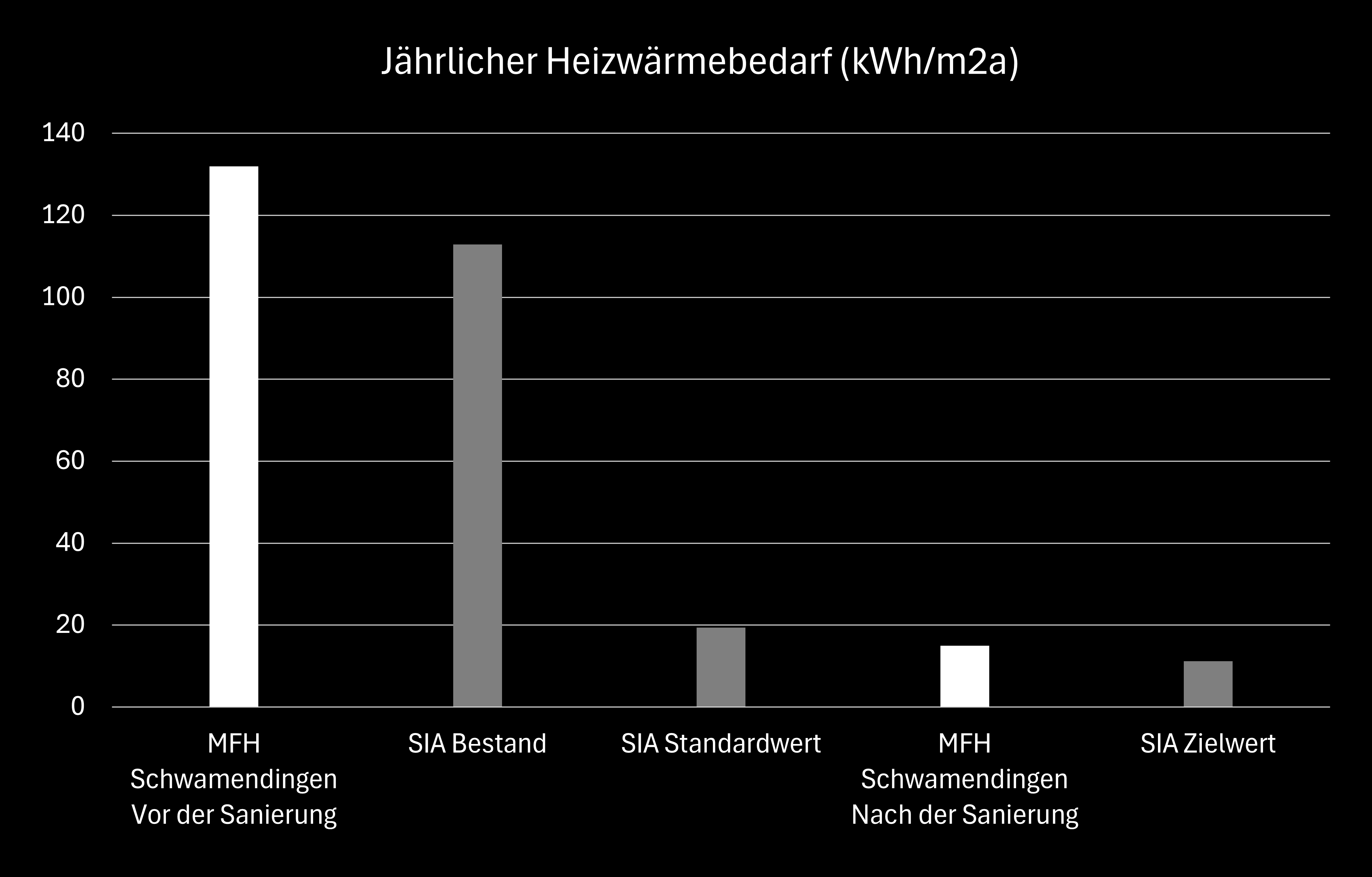
The diagram below shows the comparison between the simulation results of the Schwamendingen apartment block and the SIA 2024 reference values. It is clear that the calculated heating requirement before the refurbishment of 132 kWh/m²a is within the range or slightly above the SIA reference value of 112.9 kWh/m²a, which indicates low insulation quality and high transmission losses. After the renovation, the requirement is reduced to 15 kWh/m²a and is therefore between the SIA standard value of 19.4 kWh/m²a and the target value of 11.2 kWh/m²a.
The comparison shows that the refurbishment carried out raises the energy performance of the building to a level that exceeds the normative requirements. While the original condition reflects the typical weaknesses of an existing building with an inadequate building envelope, the result after the refurbishment proves the success of the comprehensive insulation and modernisation measures.
The deviation from the SIA guideline values illustrates that the Ubakus simulation enables a specific and detailed assessment of the energy behaviour. It also shows how targeted refurbishment steps - tailored to the actual material and climate data - can not only achieve the theoretical standard values, but even exceed them.
The diagram shows the values of the simulation results for the MFH Schwamendingen (white) as well as the reference values for the existing, standard, and target values of the SIA 2024 (gray).
Conclusion
The analysis shows that a targeted renovation of the building envelope can fundamentally improve the energy behaviour of a building. By using modern insulation materials, optimised glazing and efficient building technology, it was possible to reduce heating requirements by around 90% and primary energy consumption by 95%. This reduction emphasises the key importance of a well-designed building envelope and an efficient heat supply for energy efficiency and sustainability in existing buildings.
The significant reduction in primary energy consumption not only has a positive impact on operating costs, but also makes a significant contribution to reducing CO₂ emissions and achieving national and international climate targets. By switching from fossil fuels to electric, highly efficient heat generation systems, energy consumption becomes less dependent on finite resources and volatile energy prices in the long term.Overall, the example shows how digital tools such as Ubakus enable architects, engineers and planners to systematically analyse and quantify the energy-related weak points of a building. By simulating real building and climate conditions, different refurbishment scenarios can be precisely compared and evaluated. Such tools support data-supported and well-founded planning that leads to effective, sustainable and economically viable refurbishment measures - and thus builds a bridge between technical analysis and architectural design.
If you have any questions about the heat demand analysis or the MFH Schwamendingen project, or if you would like to share your own experiences and thoughts on thermal simulation, refurbishment measures or the use of tools such as Ubakus, please feel free to join the discussion in the forum.