Regional Potential
Section outline
-
-
Geodata as a Planning Tool
Tool: Geo Admin
Building processes today are rarely organised locally. Materials travel long distances, while excavated soil on site is treated as waste. But what actually lies directly beneath our feet? How can we integrate the potential of a site into the design process even before the first material decision is made?
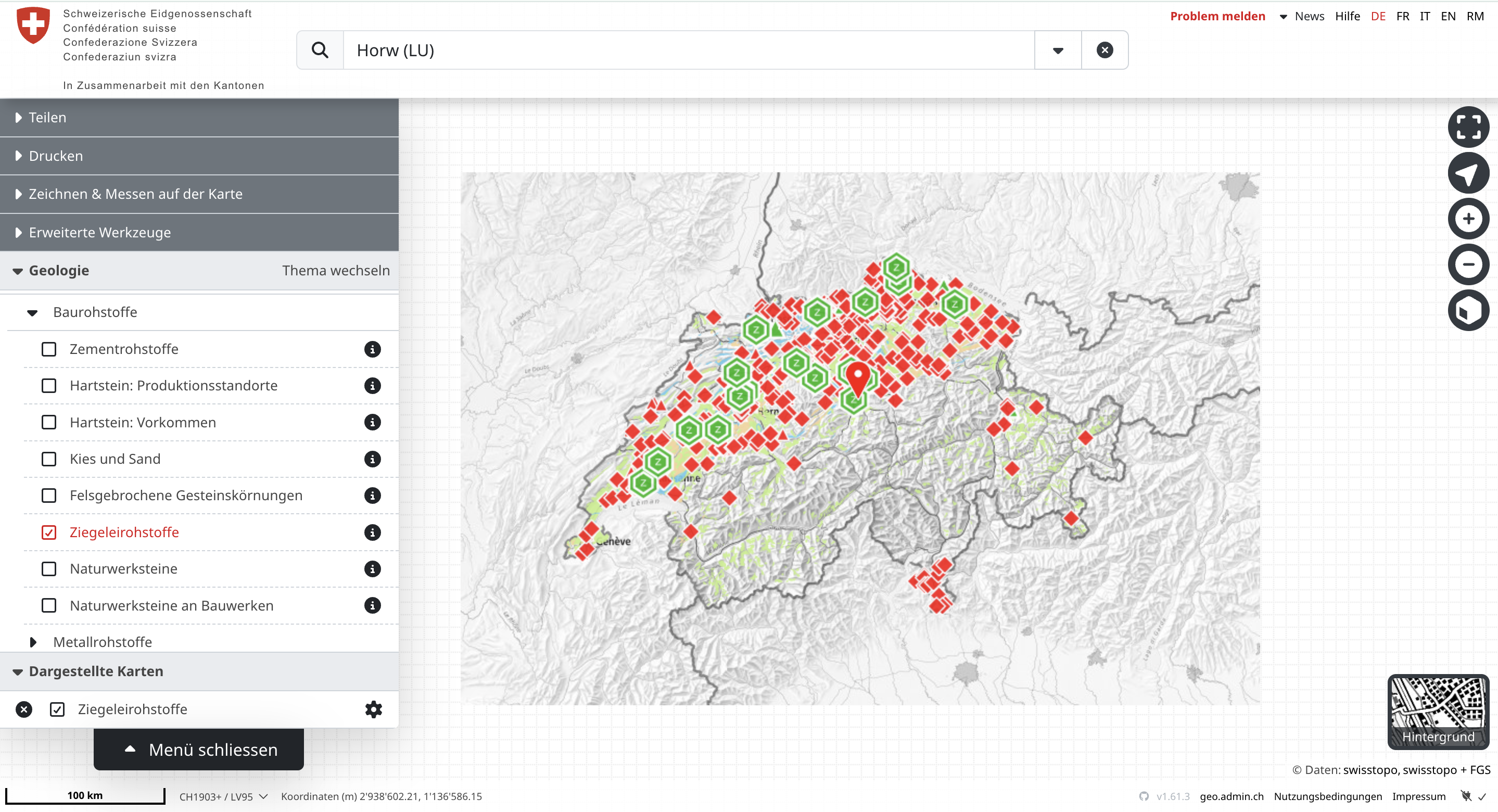
A first step begins with site analysis. On map.geo.admin.ch, geological data for Switzerland can be accessed. Among other things, brick raw materials are mapped, offering initial indications of regions with potentially suitable clay-rich soils, such as the Swiss Plateau. Even before a project begins, it is worth gaining an initial overview: Is there clay in my region? While geodata cannot replace material testing, it expands the design process by adding an additional perspective: the site as a resource.
-

View of geological data in Switzerland. Brick raw materials are highlighted as indicators of regional resources. Source: geo.admin.ch
-
From Excavation to Resource
Local building does not necessarily mean opening new extraction sites. Many construction sites already generate valuable material themselves. What is considered surplus today can become tomorrow’s building resource. Excavated soil would normally end up in landfills. By reusing clay, these disposal sites are directly relieved while resources remain in circulation. In this way, a by-product becomes a potential building material.
Concrete steps in the planning process can include contacting local excavation companies or construction sites, assessing availability, collecting material samples, analysing composition, and having qualified experts evaluate suitability for clay plaster, clay bricks, rammed earth, or poured earth. Another regional potential lies in gravel plants: washing sand and gravel produces filter cake, a mineral fine fraction that, if compositionally suitable, could serve as a raw material for earth-based construction products.
Clay is not a standardised product. It consists of varying proportions of clay minerals, silt, sand, gravel, and stones. Its properties vary depending on origin and composition, including grain size, plasticity, and moisture content, all of which determine its potential applications.
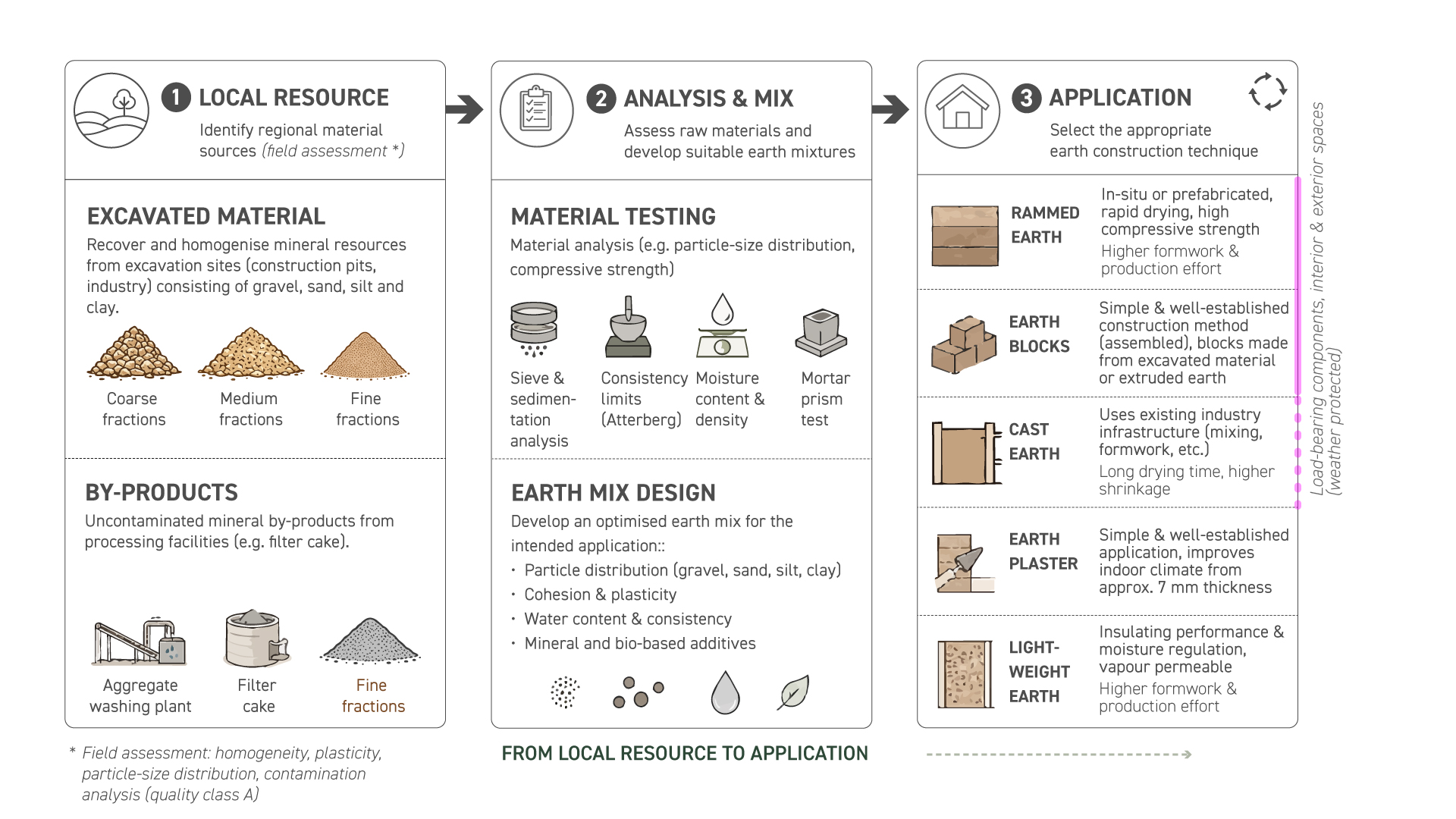
Prof. Dr. Uwe Teutsch (Lucerne University of Applied Sciences and Arts – Engineering & Architecture), project lead and member of the steering committee of “Think Earth – Regenerative Construction,” describes material assessment as a structured decision-making process. The following overview illustrates how local raw material can be transformed into a usable construction product.

-

Illustration of the evaluation process for local clay resources. Graphic: Think Earth
-
Initially, local resources such as excavation material from construction pits or mineral residual materials from gravel washing plants are identified and assessed on site in terms of homogeneity, grain size distribution, and plasticity, and are subjected to contamination analysis. These initial field assessments provide a first indication of the material’s suitability for different earth construction applications. Mineral by-products from gravel washing plants can also be used, provided contamination analyses confirm that the material is harmless. Care is taken to ensure that no contaminated flocculants such as microplastics or hydrated lime are used.
Following initial assessments, the raw material is collected and homogenised. The materials (excavation soil, filter cake, etc.) are then further evaluated through analyses such as sieve analysis, consistency limits, and strength testing. Based on these results, the earth mixture is specifically developed.
A suitable earth mixture is achieved, for example, through optimisation of grain size distribution, plasticity, binder content, water content, and mineral or biogenic additives. Only then is the appropriate application selected, such as rammed earth, earth blocks, poured earth, clay plaster, or lightweight clay.
The properties of the earth building components are specifically considered and optimised, including manufacturing and drying effort, construction processes, mechanical properties (compressive strength, shrinkage, creep coefficient, modulus of elasticity), building physics properties (thermal storage capacity, moisture regulation, insulation properties, pollutant filtration), and weather resistance.
The evaluation process demonstrates how regional resources can systematically be transformed into high-performance and context-specific construction materials.
-
“Clay and earth-based building materials can already be used in many different ways today, including in Switzerland. There are good and increasing numbers of earth construction products available. But especially the direct use of excavation material holds enormous potential – for us, this is a central issue.”
Christiane Löffler, board member of IG Lehm, architect and earth builder
-
Earth Construction in Practice
Association: IG Lehm
The use of local clay is no longer a future scenario. Numerous realised projects across Switzerland already demonstrate how excavation material can be directly integrated into contemporary construction. Many projects combine established earth building techniques with local resource use across different scales and building types.
Current examples illustrate this diversity:
- The Grubenstrasse extension in Zurich combines prefabricated timber construction with straw bale insulation finished in clay plaster.
- K.118 in Winterthur integrates reclaimed building components, straw bale construction, and clay plaster made from local excavation material.
- The multi-generational house in Altendorf applies multiple earth construction methods within a timber-earth hybrid system.
- The Hüüsli conversion in Winterthur demonstrates the broad use of local excavation clay in floors, plaster, and fibre earth applications.
- The Lehmkubus in Maloja transforms a former stable through a rammed earth cube made from regional clay and gravel, combining spatial, climatic, and architectural functions.
These projects show that local clay resources can already be effectively applied in diverse architectural, structural, and climatic contexts.
Further project overviews and technical expertise are provided by IG Lehm, the Swiss earth building association, which brings together specialist knowledge and practical implementation experience.
Building more locally therefore begins not on the construction site, but in the design process. Through mapping, collaboration with regional producers, and systematic material evaluation, the focus shifts from global supply chains toward regional cycles.
-
Added Value of Building with Clay
Ultimately, building locally with clay is more than a material choice. It influences architectural design, construction, and the indoor climate of a building. Massive clay components such as earth blocks, rammed earth, or poured earth act as thermal storage masses: they absorb heat during periods of high temperatures and release it gradually over time. Combined with night ventilation, they can reduce heat peaks and help stabilise indoor temperatures.
At the same time, clay functions as a natural moisture buffer. It regulates humidity by absorbing excess moisture and releasing it again when indoor air becomes dry. This creates a more balanced indoor climate. In combination with passive solar strategies, clay can support robust low-tech climate concepts that enhance comfort while reducing the need for costly technical cooling systems.
Digital planning tools help make these effects visible and comparable already in the design phase. Simplified simulations using the web-based tool “Ubakus” allow thermal properties of building components, including U-values, heat demand, and energy performance, to be assessed.
In addition, “Dewbee,” a Rhino/Grasshopper plugin, enables the early-stage analysis of hygrothermal properties at building scale, including heat and moisture buffering. In this way, material knowledge becomes a solid foundation for planning and design decisions.
-
Think Earth – Regenerative Construction
Project: Think Earth
Within the Innosuisse project “Think Earth – Regenerative Construction” (2023–2028), industry and research partners jointly investigate how timber and clay can contribute to circular and climate-compatible construction methods. The project develops new planning tools, material strategies, and case studies for regenerative building in Switzerland. At the same time, it promotes a shift in perspective: regional potentials should be identified, assessed, and, where possible, strategically integrated into sustainable building processes from the earliest design stages.
-