From Excavation to Resource
Local building does not necessarily mean opening new extraction sites. Many construction sites already generate valuable material themselves. What is considered surplus today can become tomorrow’s building resource. Excavated soil would normally end up in landfills. By reusing clay, these disposal sites are directly relieved while resources remain in circulation. In this way, a by-product becomes a potential building material.
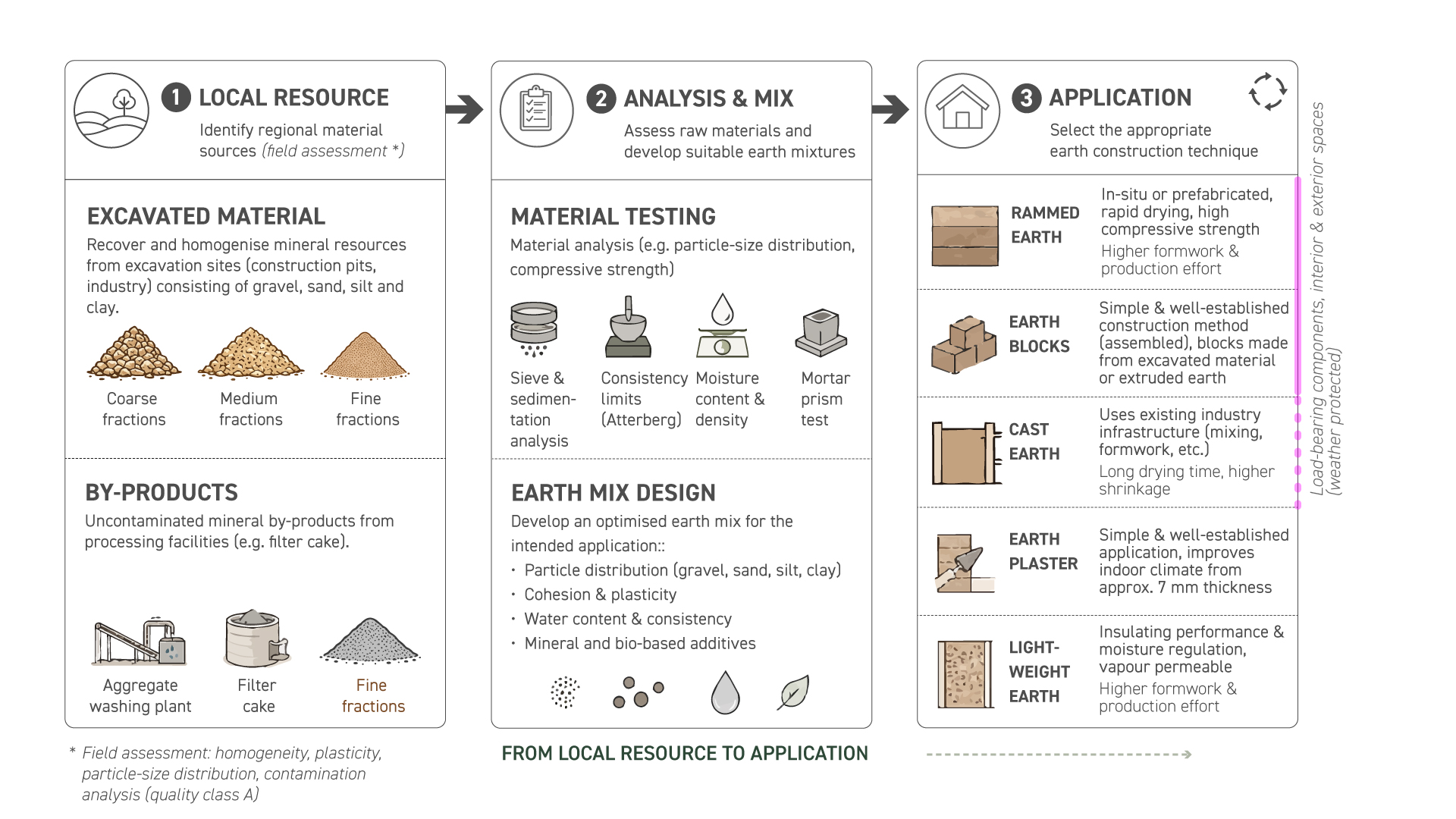
Concrete steps in the planning process can include contacting local excavation companies or construction sites, assessing availability, collecting material samples, analysing composition, and having qualified experts evaluate suitability for clay plaster, clay bricks, rammed earth, or poured earth. Another regional potential lies in gravel plants: washing sand and gravel produces filter cake, a mineral fine fraction that, if compositionally suitable, could serve as a raw material for earth-based construction products.
Clay is not a standardised product. It consists of varying proportions of clay minerals, silt, sand, gravel, and stones. Its properties vary depending on origin and composition, including grain size, plasticity, and moisture content, all of which determine its potential applications.
Prof. Dr. Uwe Teutsch (Lucerne University of Applied Sciences and Arts – Engineering & Architecture), project lead and member of the steering committee of “Think Earth – Regenerative Construction,” describes material assessment as a structured decision-making process. The following overview illustrates how local raw material can be transformed into a usable construction product.