Section outline

    • Can we design buildings today that still have a positive environmental footprint 100 years from now? Gewerbehaus K118 in Winterthur is a good example of how circular building can rise to this challenge. Instead of starting with new materials, the team reused steel beams, aluminum windows, and granite slabs from an old warehouse, combining them with natural materials like wood and straw. The result? A 60% smaller carbon footprint compared to traditional new construction. But how do we actually measure and prove these benefits? This is where Life Cycle Analysis comes in.

      Case Study: Gewerbehaus K118


    •   author Arianna Lurati 07.11.2025  

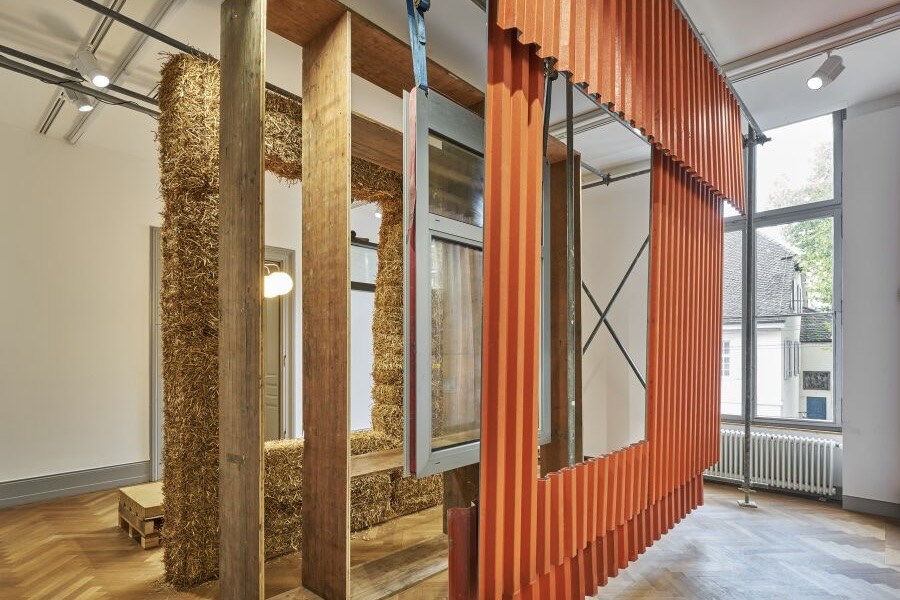
    • Photo: baubüro in situ ag

    • Understanding Life Cycle Assessment (LCA)

      LCA evaluates a building’s total environmental impact across its entire lifespan, from production (A1 to A3) and construction or assembly (A4 to A5), through use (B1 to B7), and finally to disposal (C1 to C4). It does not just assess how a building performs today, but considers the cumulative impact of every decision made throughout its life cycle. 

      The following table illustrates the classic phases of an LCA and highlights some tools for each phase, including Ubakus, the Material Pyramid, and KBOB. They help quantify environmental performance and support informed planning.

    • Manufacturing /Production  Construction Use End of life
      A1 Raw material supply
      A2 Transport
      A3 Production
      A4 Transport
      A5 Construction/Assembly 
      B1 Use
      B2 Maintenance
      B3 Repair
      B4 Replacement
      B5 Refurbishment / Renovation
      B6 EOperational energy use
      B7 Operational water use 
      C1 Deconstruction / Demolition
      C2 Transport
      C3 Waste processing / treatment
      C4 Disposal
      Ubakus /
      Material Phyramid
           
      KBOB "Herstellung" KBOB "Betriebswerte" KBOB "Entsorgung"

    • LCA Phase A1–A5: What can Gewerbehaus K118 teach us about production and construction?

      Tool: Construction Material Pyramid

      The first stages of a life cycle assessment—production (A1–A3) and construction (A4–A5)—are where most of a building’s embodied carbon is generated. Gewerbehaus K118 demonstrates two key strategies for handling building materials sustainably: reusing existing components and carefully selecting new materials based not only on their appearance, but also on their environmental impact.


    • Reuse: giving materials a second life

      At Gewerbehaus K118, planning does not begin with drawings but with identifying and collecting reusable materials. This reverses the usual approach: instead of designing first and sourcing later, available materials come first, and the design evolves accordingly.

      Each reused component, whether a steel beam, a window frame or a granite slab, is carefully measured, documented and catalogued. This makes the design process flexible and adaptable, shaped by what is available.

      Integrating reused elements avoids emissions from raw material extraction, production and transport, significantly reducing the project’s carbon footprint from the very start.

    • Plan Building Component: HAW Institut Konstruktives Entwerfen, Source Building Component Catalogue: Angst et al.: Bauteile wiederverwenden, Ein Kompendium zum zirkulären Bauen, Park Books, 2021, Photos: Martin Zeller

    • How do we evaluate emissions from building materials?

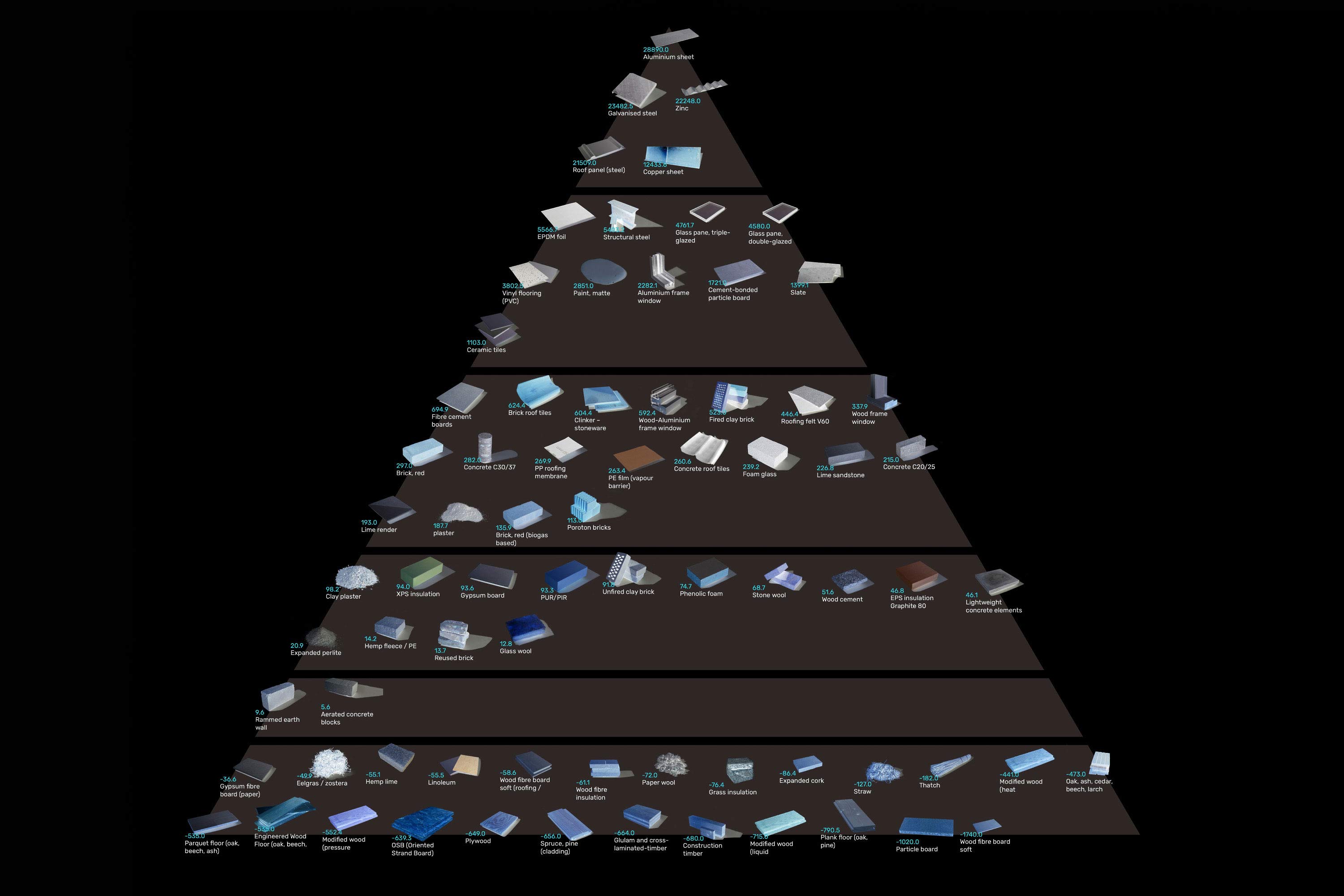
      Not all materials are equal in their environmental impact. The Construction Material Pyramid is a simple, visual tool that ranks materials by their embodied carbon.

      Take Gewerbehaus K118 as an example. For insulation, straw was chosen for its low impact. On the pyramid, straw appears near the very bottom, far below traditional options like glass wool or stone wool. It reduces embodied carbon by around 120 kg CO₂/m³ compared to these conventional materials.

      Want to explore further? Double-click any material in the pyramid to compare emissions and see other features like durability and thermal performance.


    • The illustration shows the Material Pyramid, with various building materials arranged according to their emissions. The closer a material is to the base, the lower its emissions, Source: Construction Material Pyramid


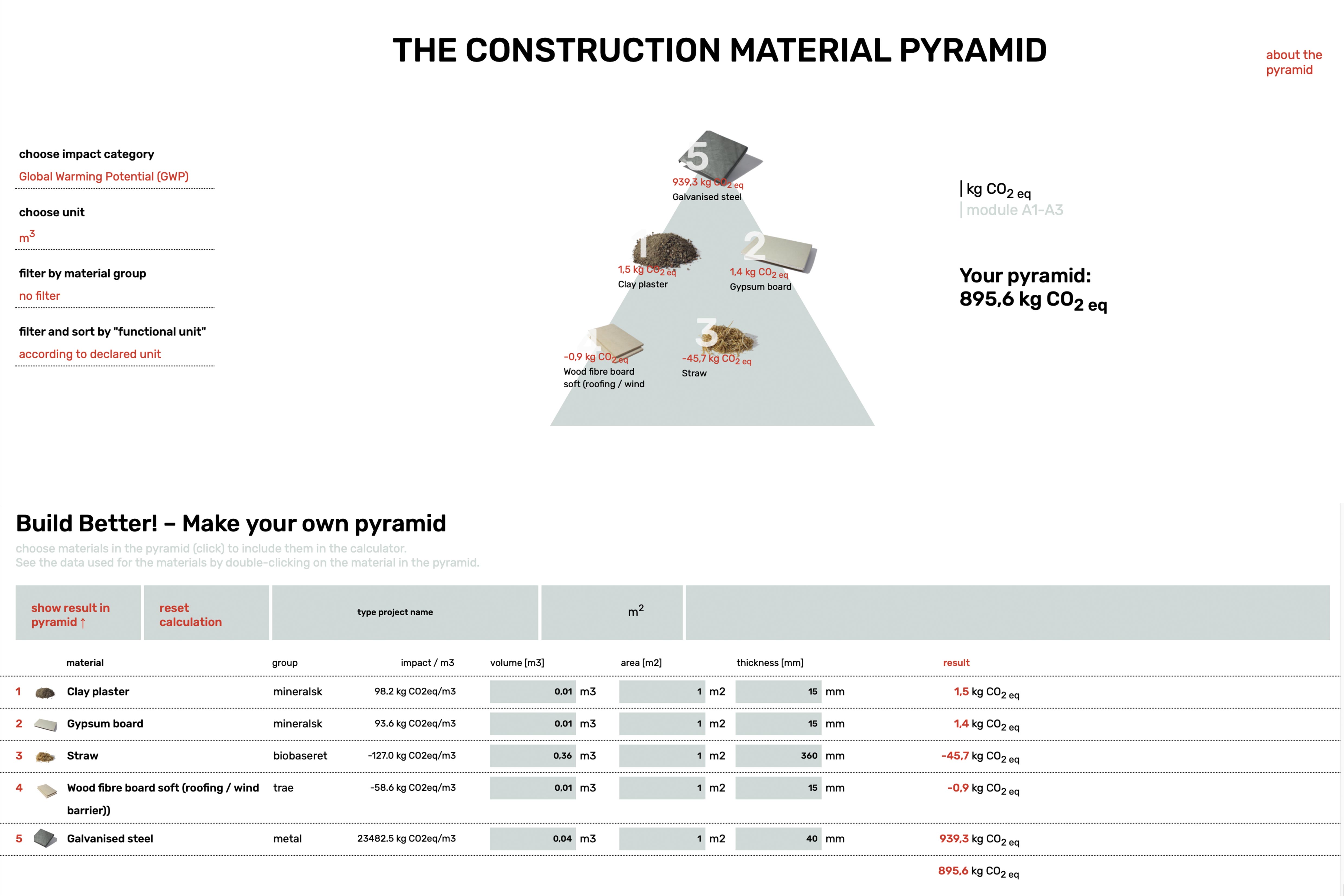
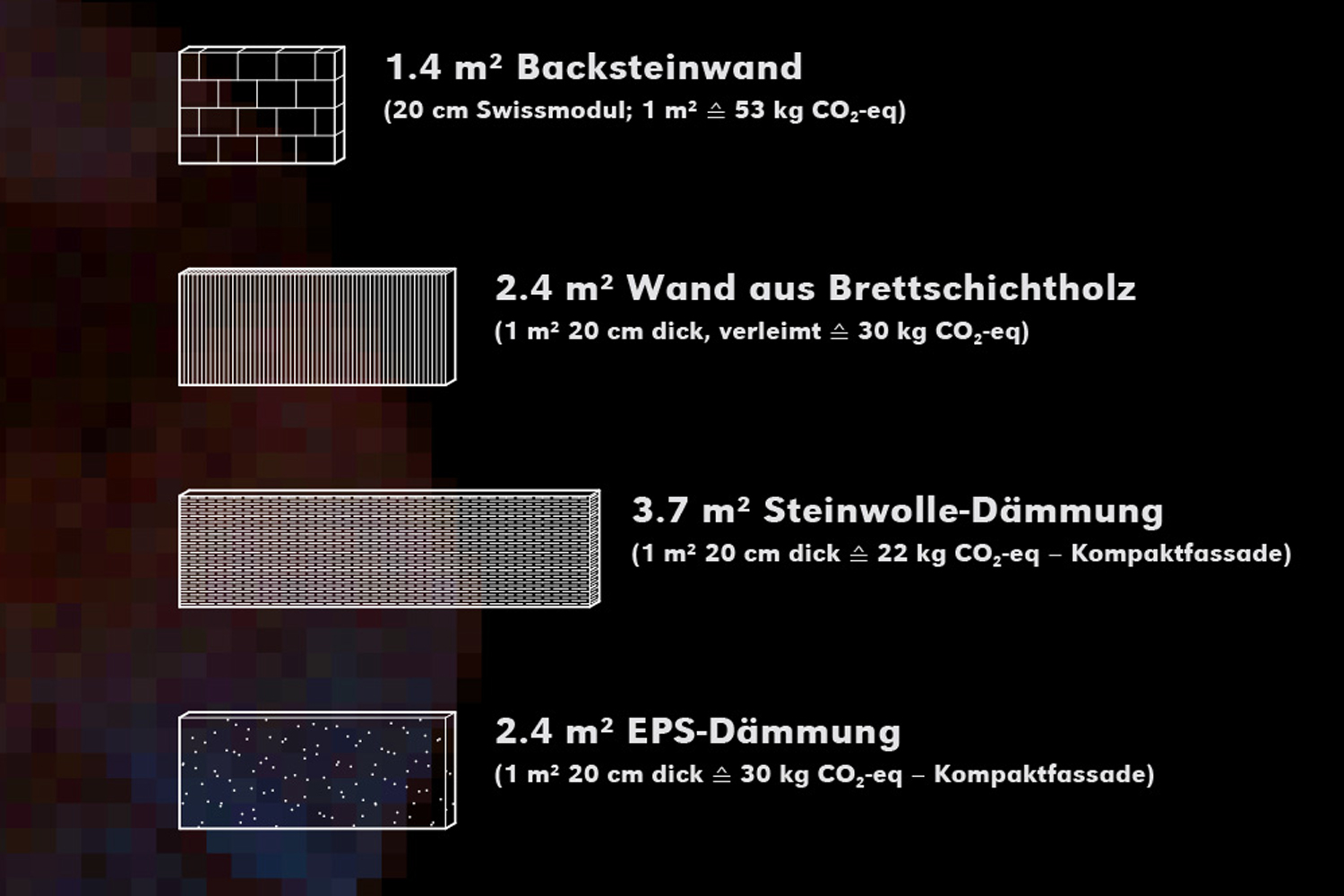
    • In addition to offering a clear overview of material emissions, the Construction Material Pyramid also lets you calculate the impact of entire building elements.

      By simply clicking on the materials used in a wall and entering their area and thickness, the tool instantly shows the total embodied emissions.

      Take Gewerbehaus K118 as an example. By combining straw insulation with other selected materials, the tool reveals that if all components were new, the external wall would emit approximately 895.6 kg CO₂e/m².

      Here’s an interesting fact: some natural materials, like straw, display negative emission values. This means they store more carbon than they emit, acting as carbon sinks and helping lower the total emissions of the wall.


    • The illustration shows the Material Pyramid, highlighting the selected materials (marked with numbers) used to calculate the emissions of the external wall of the Gewerbehaus K118, Source: Construction Material Pyramid


    • How much carbon can we save by choosing reused over new materials?

      Tool: KBOB

      The KBOB database is an essential resource for accurate carbon assessments, particularly when comparing new and reused materials. It provides environmental data for both production and construction phases, with emissions reported per kilogram of material or per square meter of building area.

      For example, new steel beams carry an embodied carbon footprint of about 2.5 kg CO₂e. per kilogram, while reused steel is closer to 0.5 kg CO₂e. per kilogram. In the Gewerbehaus K118 project, reusing 10 000 kg of steel avoided roughly 20 000 kg CO₂e., based on this difference.

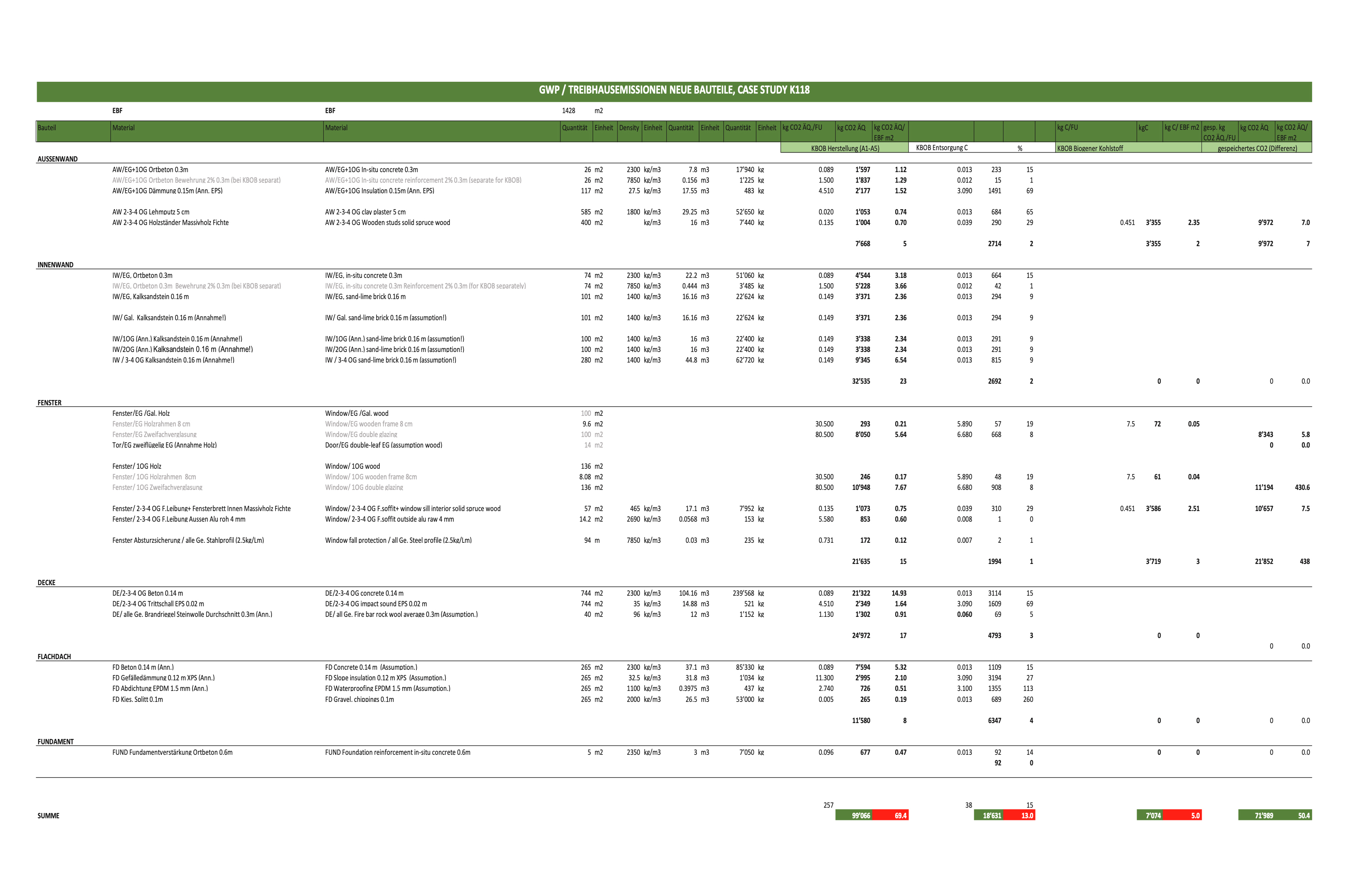
      Applied across all materials, a conventional new build would have emitted 99,066 kg CO₂e. By prioritizing reused steel and selecting natural materials such as straw and wood instead of synthetic alternatives, Gewerbehaus K118 achieved a 60% reduction in embodied carbon.

      The KBOB database also accounts for emissions from transport and assembly, which makes it possible to evaluate the benefits of local sourcing and efficient site logistics. Both strategies were used in Gewerbehaus K118 to further reduce emissions during construction phases A4 and A5.

    • The illustration shows the greenhouse gas emissions of the K118 structure if everything were built with new materials. Source: KBOB

    • Diving Deeper into Material and Construction

      Tool: Ubakus

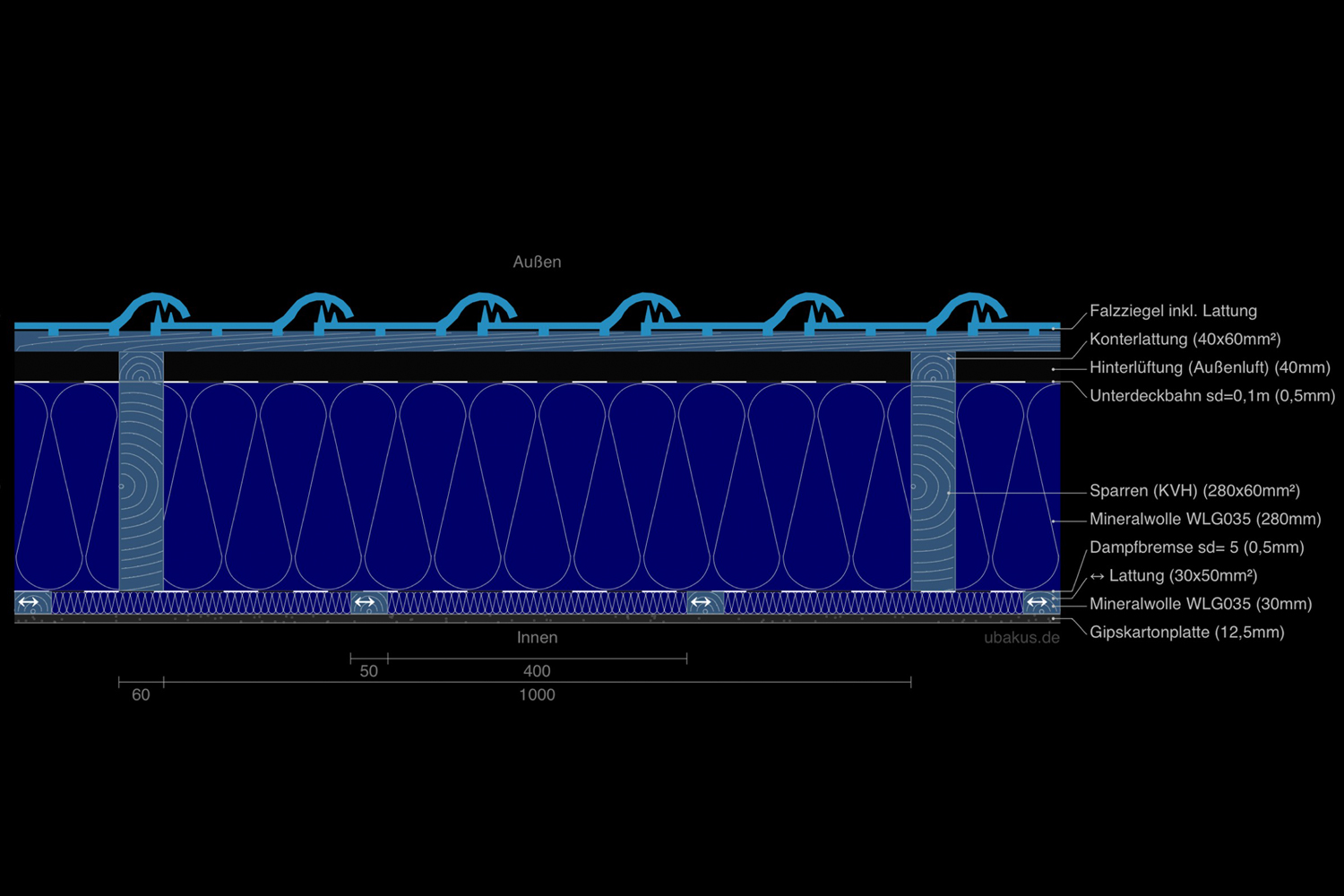
      The Material Pyramid helps you focus on individual materials and their impact. If you want more precise calculations that consider how different elements like walls, roofs, and floors are built, Ubakus is the better tool.

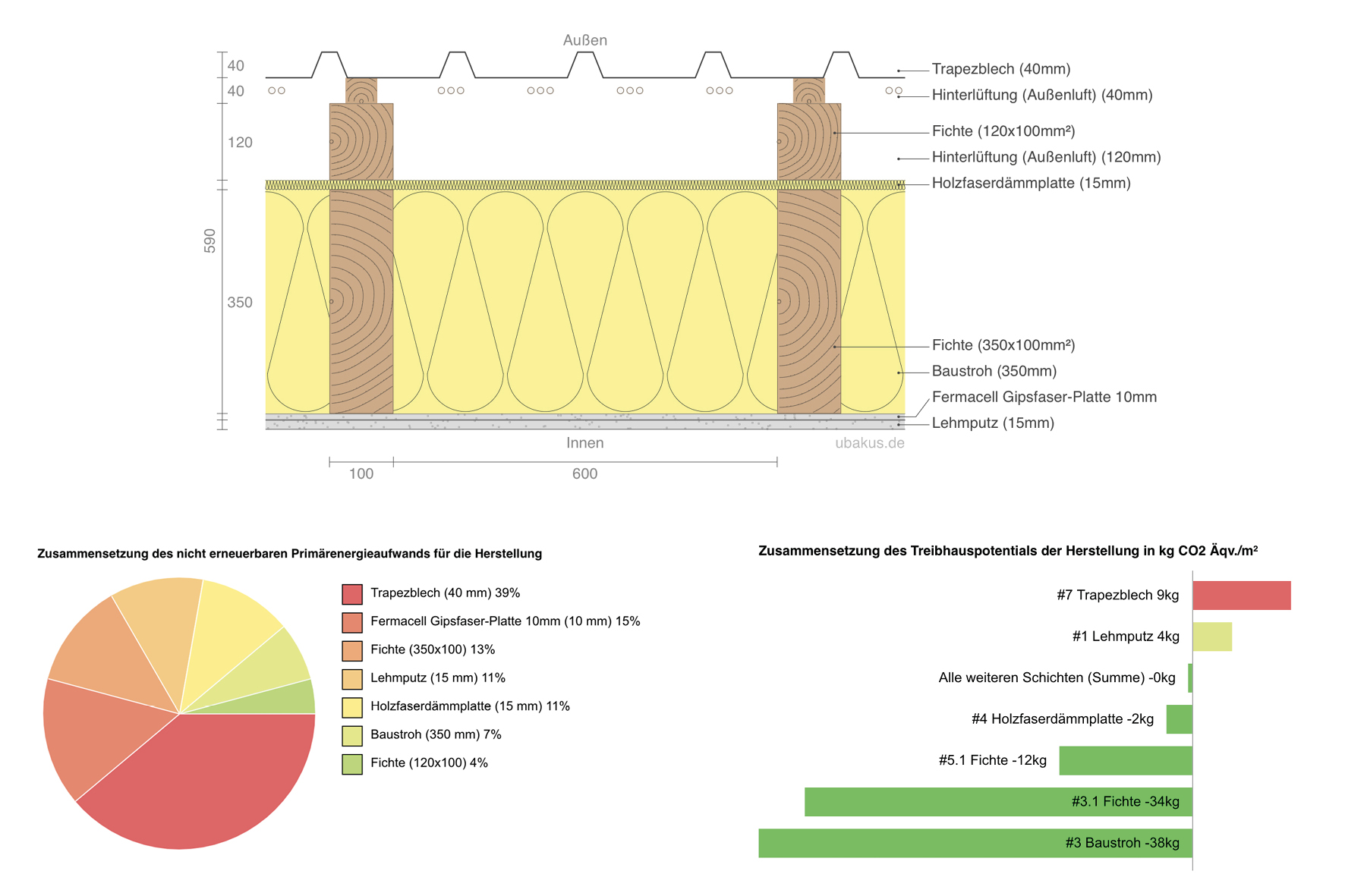
      By entering the layers of Gewerbehaus K118’s external wall into Ubakus, you get detailed visualizations that reveal the overall environmental balance.

    • Detail of the external wall of the Gewerbehaus K118, showing the different material layers and their associated emissions. Source: Ubakus

    • LCA Phase B1–B7: What can Gewerbehaus K118 teach us about use?

      Understanding which materials matter is just one part of the picture. Life cycle analysis also shows us when carbon is emitted during a building’s lifetime. For Gewerbehaus K118, this perspective is particularly useful because so much effort was made to reduce embodied carbon at the start of the building’s life.

    • How can we calculate operational emissions?

      Tool: KBOB

      To start, we look at the building’s energy consumption. According to SIA standards, K118 uses 15 000 kWh per year for heating and 5 000 kWh per year for electricity, spread across a floor area of 1 534 m². Dividing the energy by the floor area reveals that each square meter consumes roughly 9.78 kWh/year for heating and 3.26 kWh/year for electricity, giving a clear picture of how energy is distributed across the building.

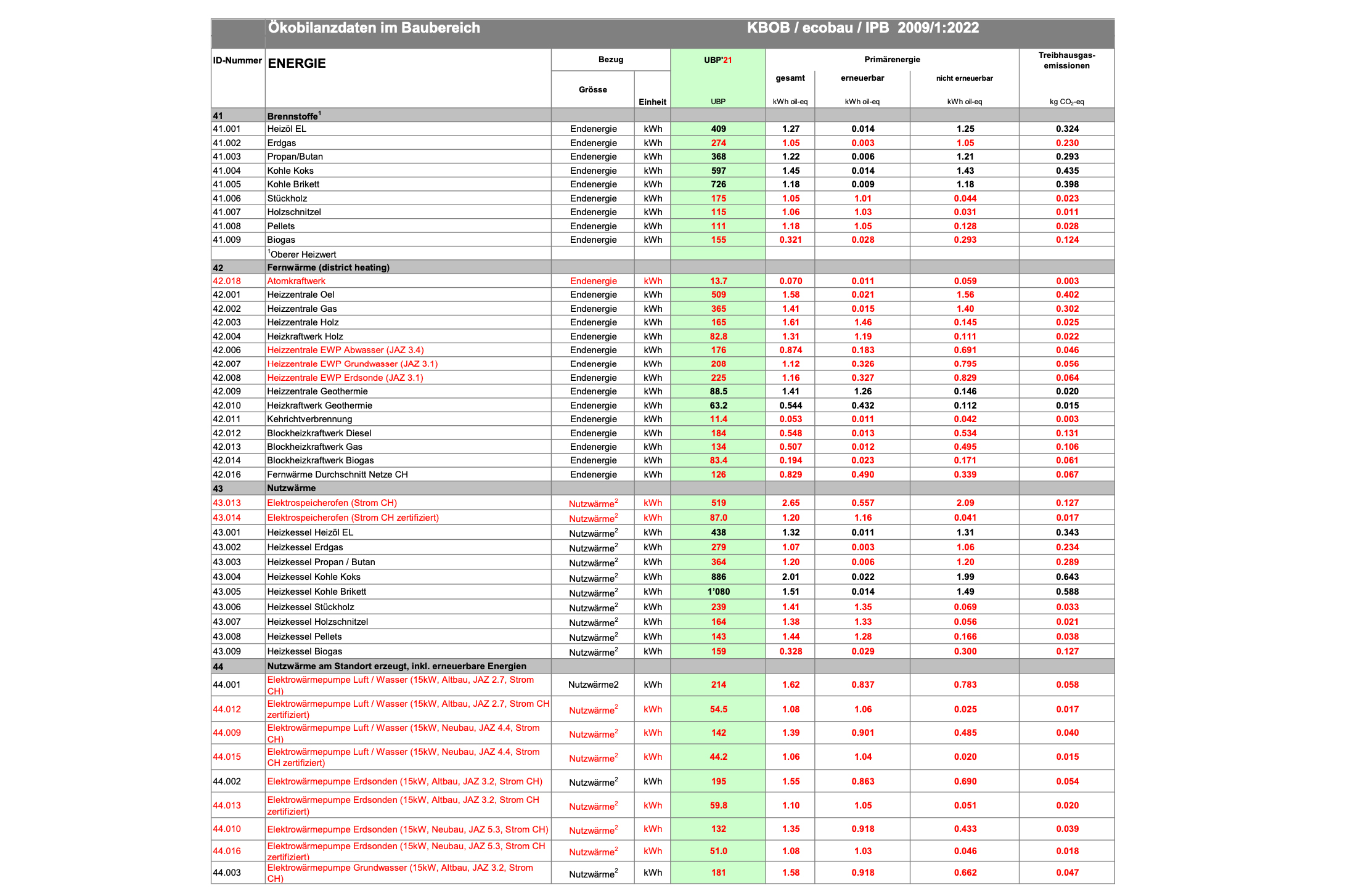
      Next, we translate this energy into greenhouse gas emissions using KBOB emission factors, which indicate how much CO₂ is produced per kWh. For heating, with a factor of 0.25 kg CO₂/kWh, each square meter produces about 2.44 kg CO₂ per year. Electricity, at 0.30 kg CO₂/kWh, adds roughly 0.98 kg CO₂ per m² per year. Together, the building emits approximately 3.42 kg CO₂ per square meter annually, making its previously invisible environmental impact tangible.

      Looking at the bigger picture, K118 is expected to operate for 80 years. Multiplying the annual emissions by its lifespan gives about 273.6 kg CO₂ per m² over the building’s lifetime, or around 419 700 kg CO₂ for the entire structure. This calculation provides a clear understanding of the building’s operational footprint and complements the emissions from construction and materials.

    • KBOB table with reference values, Source: KBOB

    • How does carbon emission evolve over time?

      Tool: GHG Emissions Timeline

      Understanding a building’s emissions means knowing not only how much carbon is released, but also when.

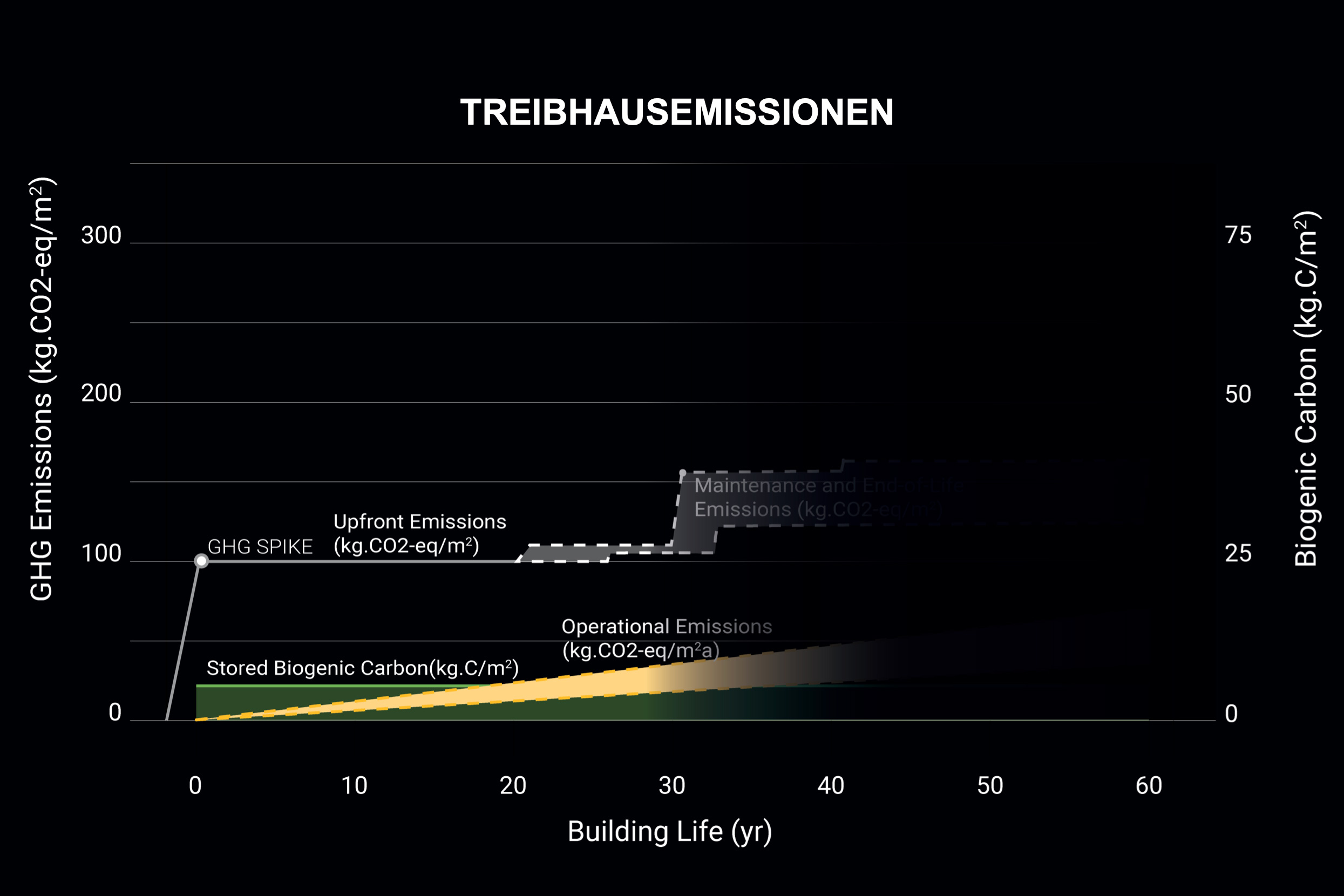
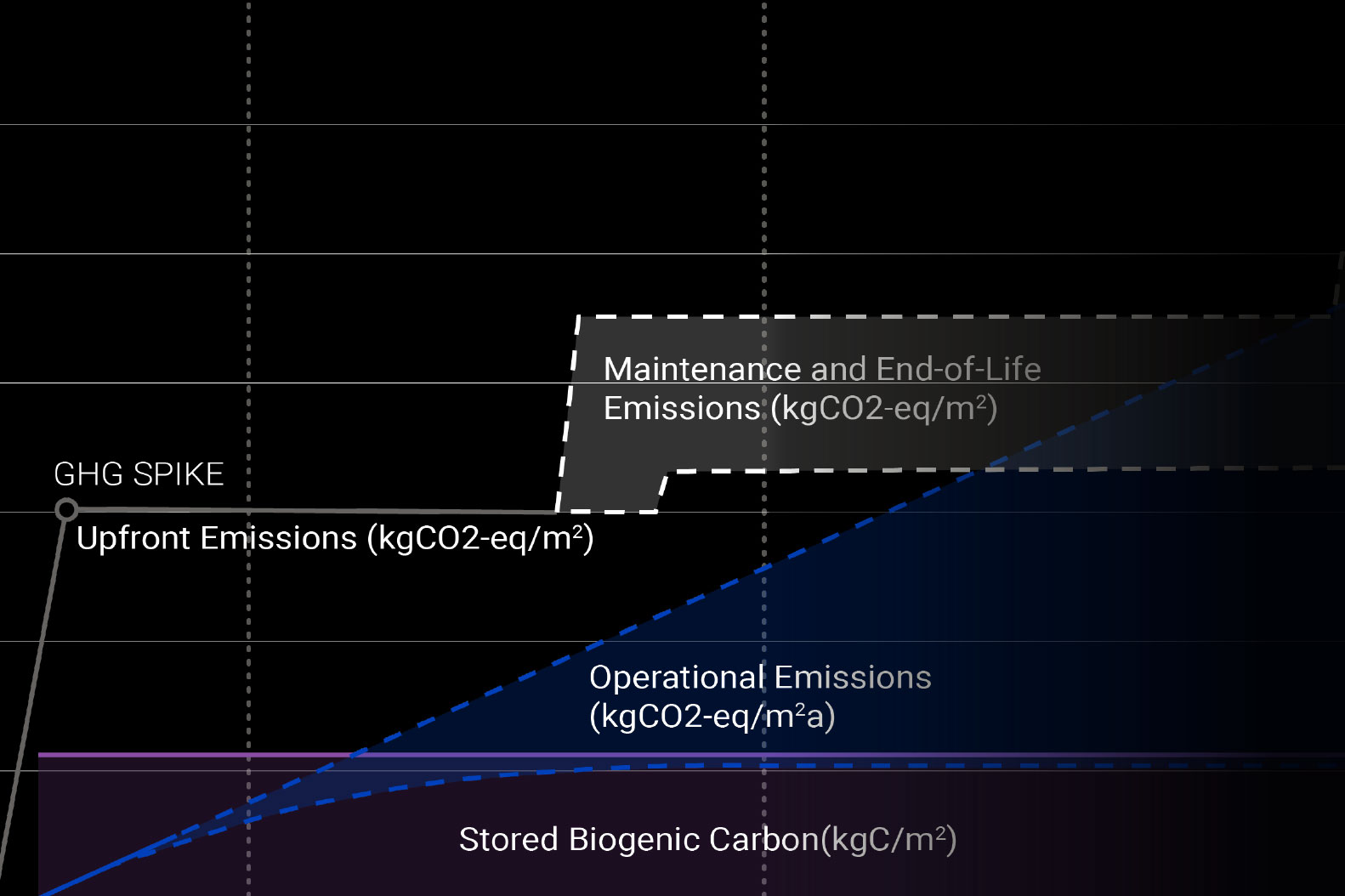
      The GHG Emissions Timeline makes visible what usually remains hidden: the moment carbon is emitted throughout the building’s life cycle.

      Unlike a traditional LCA, which gives a single number, the timeline dynamically shows how emissions evolve over time, highlighting design choices and their impact.
      Bands, lines and icons illustrate quantities, uncertainties and key events, such as system changes or construction phases, adapting to surface area, users or other parameters.

      In the case of Gewerbehaus K118, the timeline reveals how reuse strategies and natural materials helped reduce emissions from the very first stages.

      Production (A1–A3): The reuse of structural elements from a dismantled warehouse dramatically reduces emissions in this phase, especially compared to producing new steel or concrete.

      Construction (A4–A5): Transport and on-site assembly still generate emissions, but the compact logistics and local sourcing in K118 help keep these relatively low.

      Use phase (B1–B7): Over the next 80 years, emissions depend mostly on heating and electricity. With energy-efficient design and photovoltaics, operational emissions remain minimal.

      End-of-life (C1–C4): Although predicting the future is difficult, K118 is designed for disassembly. The emissions forecast assumes that most materials can be reclaimed again, reinforcing the building’s circular vision.

      This approach allows designers, students, and stakeholders to understand not only how much carbon is emitted, but also when it occurs, making the building’s environmental impact visible and supporting better, more sustainable decisions throughout its lifetime.

    • The illustration shows greenhouse gas emissions over time, with uncertainties highlighted by shaded areas. Future energy and emission targets are marked, influencing CO₂ emissions from that point onward. Source: GHG Emissions Timeline

    • LCA Phase C1–C4: What’s Next? Designing for the future

      K118 is designed for future disassembly and reuse. This strategy anticipates low emissions during demolition, because many materials can be reclaimed once again—completing the circular loop.

      With tools like KBOB and the Material Pyramid, we can simulate end-of-life scenarios and understand the potential of reuse even 50–100 years into the future.

    • Do you have questions or comments?

      If you have questions about life cycle assessment, the Gewerbehaus K118 project, or want to share your own experiences, ideas, or insights related to real-world projects or tools you’ve used, we warmly invite you to join the discussion in the forum.

This is a non-production site